Face Shapes Chart: 7 Face Types and How to Identify Yours
A practical reference for reading face shape charts, comparing the main face types, and checking your result before using hairstyle or glasses recommendations.

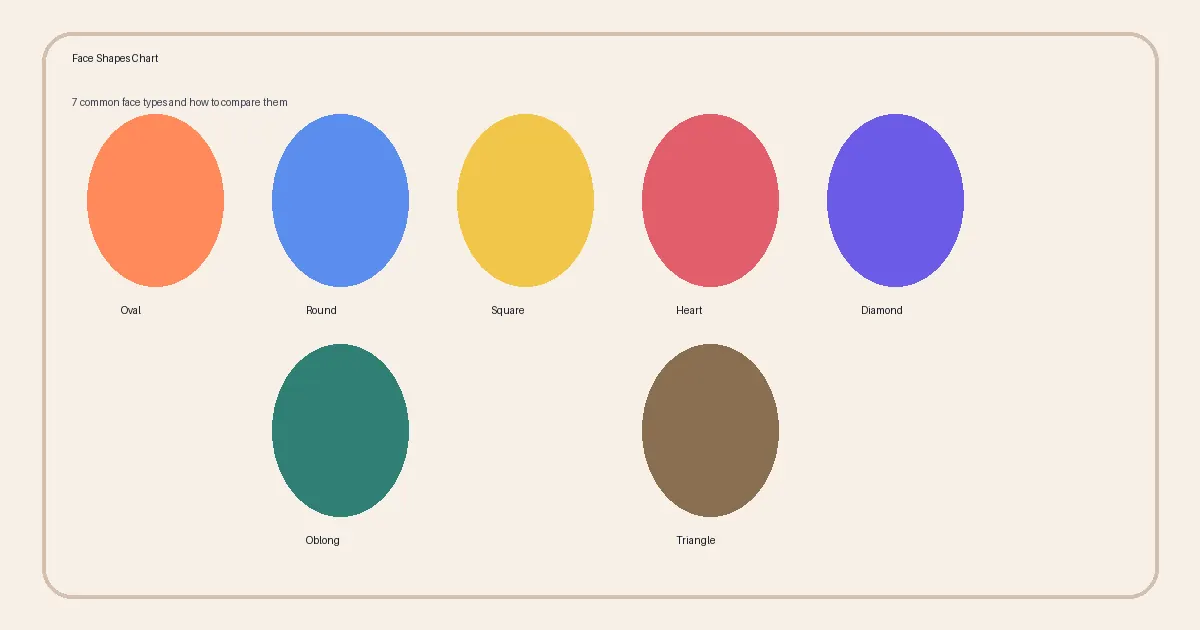
Table of Contents
Most face shape guides assume you already know what an oval, round, square, or heart face looks like. In practice, many users need a cleaner reference first. A useful face shapes chart should not only label the seven common types, but also explain what to compare, where people misread their outline, and what to do when a photo result feels close between two types.
Face Shapes Chart Overview
Use this table as a fast visual checklist. The goal is not to chase a perfect label, but to narrow your shape down to the closest pattern before applying hairstyle, glasses, or beard advice.
| Face shape | Main visual features | What usually measures widest | Best next step |
|---|---|---|---|
| OvalBalanced and slightly longer than wide | Soft jawline, balanced forehead and cheekbones, face length clearly but not dramatically longer than width. | Face length is longest; forehead and jaw are relatively close. | Use hairstyle or glasses recommendations directly. |
| RoundSoft outline with similar width and length | Rounded cheeks, minimal sharp angles, width close to length. | Cheekbones are often widest; length and width are close. | Check styles that add structure or vertical balance. |
| SquareStrong jaw and broad forehead | Defined jawline, straighter face sides, broad forehead. | Forehead, cheekbones, and jawline sit in a similar width range. | Look for glasses or haircuts that soften angles. |
| HeartWider forehead with narrower chin | Broad upper face, tapering lower face, narrower pointed chin. | Forehead is usually widest; jaw narrows visibly. | Compare fringe, frame width, and chin balance advice. |
| DiamondWidest at the cheekbones | Narrower forehead and jaw, strong cheekbone width, tapered chin. | Cheekbones clearly measure widest. | Confirm with measurements if you are also considering heart shape. |
| OblongLonger face with straighter sides | Noticeably long outline, forehead and jaw close in width, less curve through the cheeks. | Face length is much longer than width. | Choose styles that reduce visual length. |
| TriangleWider jaw than forehead | Lower face is broader, forehead appears narrower, jawline dominates the outline. | Jawline is widest. | Use styles that bring balance to the upper face. |
How to Read a Face Shape Chart Correctly
People often focus on only one feature, such as a strong jaw or a broad forehead. A better method is to compare the whole outline in order.
- Check the longest line first: If your face length is clearly longer than your width, you are usually comparing oval or oblong rather than round or square.
- Find the widest area: The forehead, cheekbones, or jawline usually tells you which group to test first. Heart shapes often start wider at the forehead, while triangle shapes are wider at the jaw.
- Judge the jawline shape: A rounded jawline often points toward oval or round. A sharper, flatter jawline often points toward square.
- Compare close neighbors: If you are between oval and oblong, or heart and diamond, use measurements rather than intuition. Small photo angles can make these pairs look similar.
How to Measure Your Face Shape
You do not need professional tools. A front-facing photo, good lighting, and four simple width checks are enough for most people.
- Forehead width: Measure the widest horizontal point across the forehead, usually midway between the brows and hairline.
- Cheekbone width: Measure from one outer cheekbone to the other. This is often the widest point for diamond faces.
- Jaw width: Measure from the base of one jaw corner to the other, or compare each jaw side and double it.
- Face length: Measure from the center of the hairline to the bottom of the chin with your head upright.
Measurement tip
If your lengths are very close or your hairstyle hides the outline, compare a manual measurement result with our face shape calculator or photo detector before making styling decisions.
Common Face Shape Chart Mistakes
Most wrong classifications happen because the chart is read from a tilted selfie, a hairstyle with too much volume, or a beard that changes the outline.
- Using a tilted phone angle: A camera held too high or too low can stretch the face and make oval look oblong.
- Letting hair hide the forehead: Heavy bangs or side volume can make a heart face look round or square.
- Ignoring the beard effect: A full beard can widen the jaw and temporarily push a softer face toward a square impression.
- Over-focusing on one feature: A broad forehead alone does not make a face heart-shaped. You still need to compare cheekbones, jaw width, and chin shape.
What to Do After You Identify Your Face Shape
The chart is only the reference layer. Once you know your closest type, the next step is to apply that result to a real decision.
Use a calculator for borderline cases
If you are split between oval and oblong, or heart and diamond, manual measurements help confirm where your proportions actually land.
Use a detector for quick styling choices
Photo-based detection is useful when you mainly want hairstyle or glasses direction and do not want to compare measurements by hand.
Match the advice to the goal
Hairstyle pages, glasses guides, and grooming rules often start from the same face shape result but solve different problems. Keep the goal specific.
Face Shapes Chart FAQ
Related Face Shape Tools
- Face Shape Calculator - check forehead, cheekbone, jaw, and face-length ratios manually.
- Triangle Face Shape Guide - identify a narrower forehead and wider jaw.
- Free Face Shape Detector - upload a photo for a faster face shape estimate.
- Face Shape Detector for Glasses - apply your face shape to frame recommendations.
- Heart Face Shape Guide - identify a wider upper face and narrower chin before choosing bangs, glasses, or styling.
- Face Shape Quiz - answer 7 structure questions before you confirm a borderline face type.
Last updated: 2026-07-11