Diamond Face Shape: How to Tell, What Works, and What to Avoid
A practical guide to recognizing a diamond face shape, checking it against nearby face types, and choosing hairstyles, glasses, and grooming choices that balance strong cheekbones.

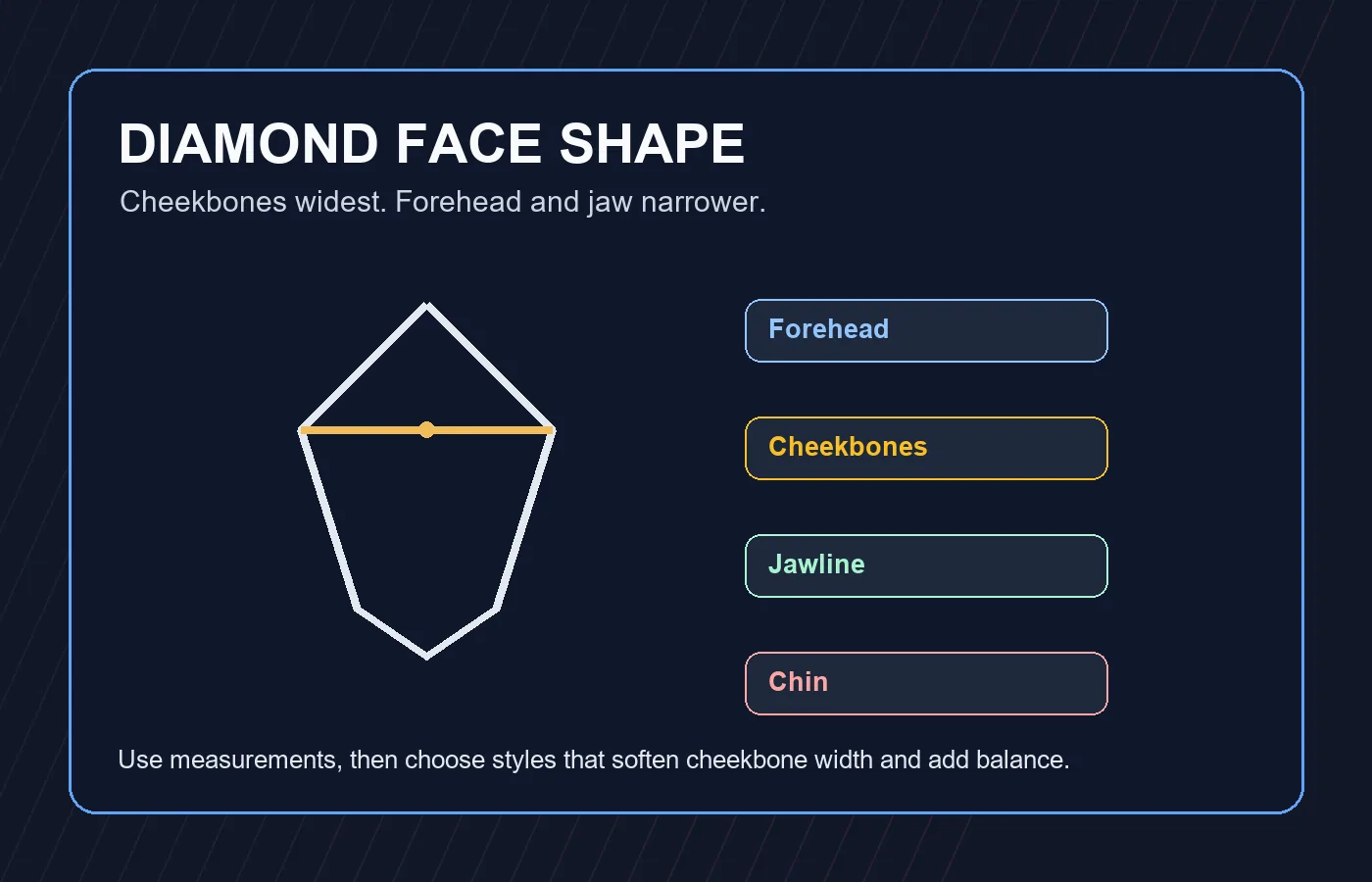
Table of Contents
Search results for diamond face shape often split the topic into separate hairstyle, glasses, and celebrity examples. That can be confusing if you are still trying to confirm the shape. This guide keeps the order practical: identify the shape first, compare it with heart and oval, then use the result for hair, glasses, beard, and makeup choices.
Diamond Face Shape Signs
A diamond shaped face is defined by proportion, not by one sharp feature. Look for the pattern created by the cheekbones, forehead, jaw, and chin together.
- Cheekbones are the widest point: This is the strongest signal. The cheek area reads wider than both the forehead and the jawline.
- Forehead looks narrower than the cheeks: Unlike many heart-shaped faces, the upper face does not usually dominate the outline.
- Jawline narrows toward the chin: The lower face often tapers, making the chin look more pointed or compact.
- Face length is moderate to long: Many diamond faces are slightly longer than wide, but not as stretched as a classic oblong face.
Best first check
If you only remember one rule, use cheekbone width as the anchor. When cheekbones are clearly widest and both the forehead and jaw are narrower, diamond is more likely than oval, round, or square.
How to Measure a Diamond Face Shape
Use a straight front-facing photo or a mirror. Keep hair away from the forehead and avoid wide-angle selfies, because camera distortion can make the cheek area look larger than it is.
- Measure forehead width: Compare the widest visible point across the forehead, usually between the hairline and brows.
- Measure cheekbone width: Measure from the outer edge of one cheekbone to the other. For a diamond face shape, this number should stand out.
- Measure jaw width: Compare the jaw corners, or measure one side from the chin to the jaw corner and double it.
- Check face length: Measure from the hairline to the chin. Length helps separate diamond from round and square when widths feel close.
- Compare the pattern: A likely diamond pattern is cheekbones widest, forehead and jaw narrower, and a tapered chin. If the forehead is widest, compare heart shape instead.
Diamond vs Heart vs Oval Face Shape
Most confusion happens between diamond, heart, and oval. The table below keeps the distinction simple and useful for styling decisions.
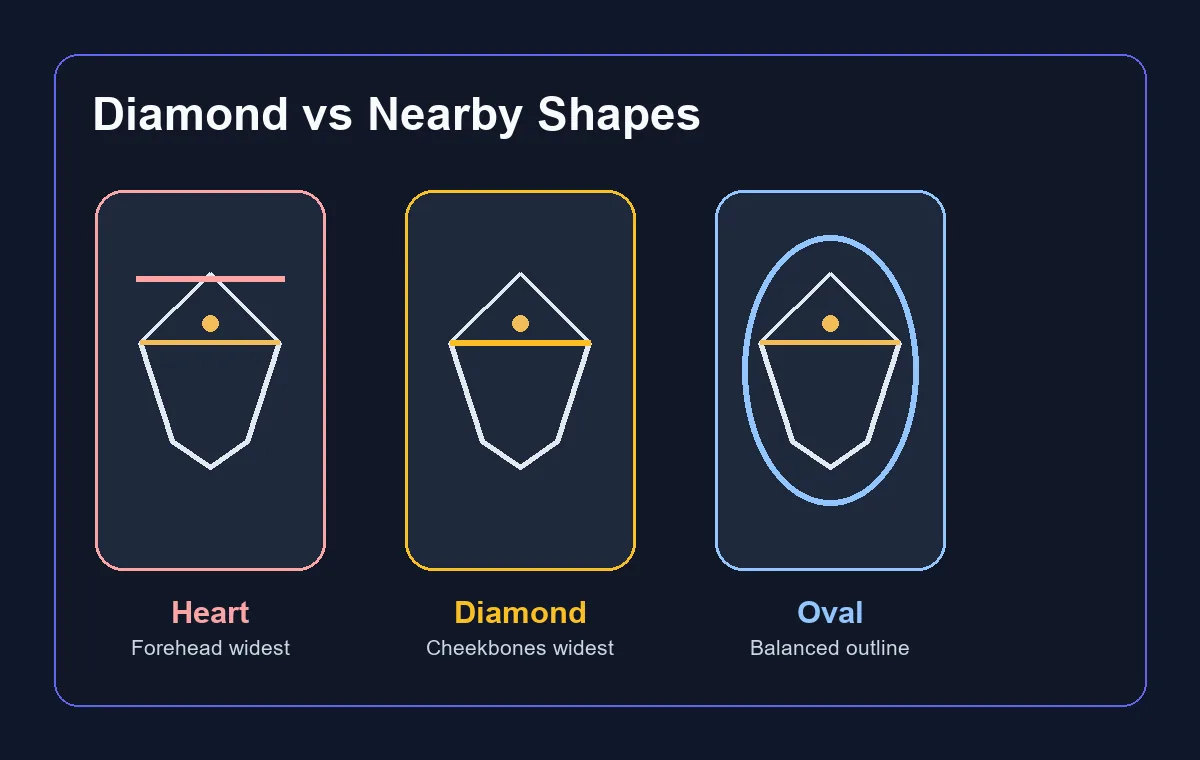
Diamond is easiest to separate from heart and oval when you compare the widest area, not just the chin.
| Shape | Widest area | Chin and jaw | Best check |
|---|---|---|---|
| DiamondCheekbone-led outline | Cheekbones are clearly wider than the forehead and jaw. | Jaw tapers and the chin may look narrow or pointed. | Measure cheekbone width first, then compare forehead and jaw. |
| HeartUpper-face-led outline | Forehead or temples usually read widest. | Chin narrows, but cheekbones are not always the widest point. | Look at whether the forehead is wider than the cheekbones. |
| OvalBalanced longer outline | Cheekbones may be widest, but the difference is gentle. | Jaw and chin are softer and less tapered. | Check whether the face feels balanced rather than angular. |
Best Hairstyles for a Diamond Face Shape
The goal is usually not to hide cheekbones. Strong cheekbones are often the feature people want to keep. The better goal is to avoid adding harsh width exactly where the face is already widest.
| Styling goal | Try | Be careful with |
|---|---|---|
| Soften strong cheekbones | Side parts, soft waves, curtain fringe, layered bobs, or medium lengths that move below the cheekbone. | Very wide volume exactly at cheekbone level. |
| Add balance near the forehead | Textured fringe, swept bangs, gentle top movement, or layers that do not expose all forehead width. | Flat center parts with no softness if they make the upper face look narrow. |
| Balance a narrow jaw or chin | Layers that open near the jaw, chin-length softness, or beard weight below the cheeks for men. | Pointed goatees or very tight sides that make the chin look sharper. |
Glasses, Beard, and Styling Tips for Diamond Faces
Once the shape is confirmed, style choices become easier because you know where balance is needed.
Glasses for diamond face shape
Look for frames that add balance to the brow line and avoid squeezing the cheek area. Oval, rimless, browline, cat-eye, and softly rounded rectangular frames often work well. Very narrow frames can make the cheekbones look even wider by comparison.
Diamond face shape men
For men, the same proportions apply. Medium texture on top, controlled side volume, and beard shapes that add a little weight near the jaw can balance prominent cheekbones. Very tight sides plus a pointed chin beard can exaggerate the diamond outline.
Makeup and contour direction
For makeup, keep the focus soft. Heavy contour directly under already prominent cheekbones can make the face look sharper. Gentle highlight near the center of the forehead and chin can help the outline feel more balanced.
Common Diamond Face Shape Mistakes
A wrong result usually comes from photo angle, hair coverage, or comparing only one feature.
- Calling every pointed chin a diamond: A pointed chin can also appear on heart-shaped faces. The cheekbones need to be the widest point for diamond to be the best match.
- Ignoring hairstyle volume: Hair that expands around the temples can make a diamond face look more oval or heart-shaped in photos.
- Using a tilted selfie: A high or close camera can widen the cheek area and narrow the jaw artificially.
- Treating the label as a rulebook: Face shape is a styling shortcut. If a recommended haircut or frame conflicts with your hair texture, glasses size, or personal style, adjust the advice rather than forcing it.
Diamond Face Shape FAQ
Related Face Shape Tools
- Face Shape Calculator - compare forehead, cheekbone, jaw, and length ratios.
- Face Shapes Chart - see diamond next to the other six common face types.
- Face Shape Detector for Glasses - turn your face shape result into frame suggestions.
- Face Shape Hairstyle Detector - connect your result to haircut and styling ideas.
Last updated: June 11, 2026