Triangle Face Shape: How to Identify It and Style It Well
A practical guide to the narrower-forehead, wider-jaw pattern—plus the measurements, comparisons, hairstyles, and glasses that make the result useful.


Table of Contents
Triangle face shape is easy to confuse with heart, diamond, square, and oblong because naming systems are inconsistent. Some sites even use triangle when they mean inverted triangle. The reliable approach is to ignore the label at first and compare four areas: forehead, cheekbones, jaw, and face length. This guide uses triangle for a face that widens toward the jaw and treats inverted triangle as a separate, top-heavy pattern.
Triangle Face Shape Signs
Look for a repeated lower-face emphasis rather than one dramatic feature. A strong jaw alone does not prove the shape if the forehead is equally wide.
- Jaw is the widest area: The jaw corners or lower cheeks extend farther than the forehead and usually farther than the cheekbones.
- Forehead looks comparatively narrow: The temple area appears more compact, especially with hair pulled away from the face.
- Cheekbones create a gradual transition: They usually sit between the narrower upper face and broader jaw instead of forming the widest point.
- Chin may be broad or softly tapered: The key is the width of the jaw as a whole, not whether the chin is pointed, rounded, or flat.
- Face length varies: Triangle faces can be short, balanced, or long, so length should refine the result rather than decide it alone.
Fastest confirmation
Trace an imaginary line from each temple down to the jaw corners. If those lines flare outward and the jaw is clearly broader, triangle is plausible. If they taper inward, compare heart or inverted triangle instead.
How to Measure a Triangle Face Shape
Use a straight-on photo taken at eye level, with a neutral expression, hair off the forehead, and no wide-angle selfie distortion. Flexible tape or a photo ruler both work; consistency matters more than perfect precision.
- Forehead width: Measure the widest visible distance across the forehead, usually between the temples.
- Cheekbone width: Measure across the most prominent points of the cheekbones without following the curve of the skin.
- Jaw width: Measure from one jaw corner to the other, or measure one side from chin to jaw corner and double it.
- Face length: Measure from the center of the hairline to the lowest point of the chin.
- Compare the pattern: Triangle is most likely when jaw width is clearly greater than forehead width and cheekbones form an intermediate step.
Small differences can come from hairline shape, camera angle, facial asymmetry, or body composition. Use the visual pattern and measurements together rather than applying a rigid ratio cutoff.
Triangle vs Heart, Diamond, and Inverted Triangle
The direction of width is the fastest separator. Triangle grows wider toward the jaw; heart and inverted triangle grow narrower toward the chin; diamond peaks at the cheekbones.
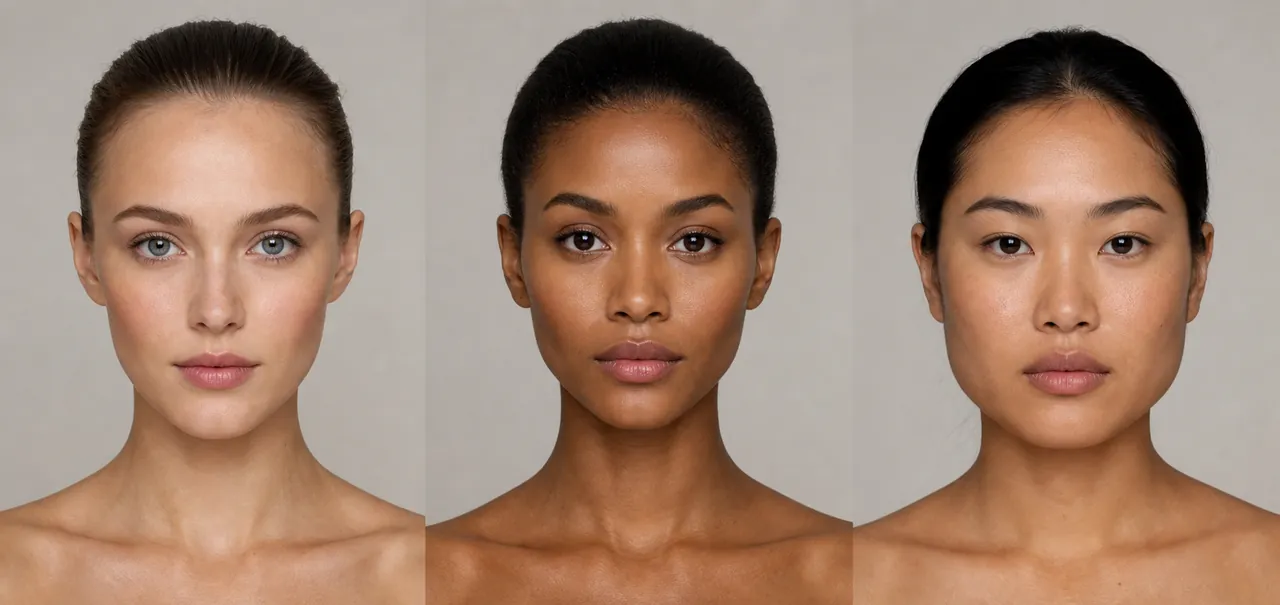
Editorial comparison of upper-face, cheekbone, and jaw emphasis. Real faces vary, so use the image as a proportion guide rather than a diagnostic template.
| Shape | Widest area | Jaw and chin | Best check |
|---|---|---|---|
| Triangle | Jaw or lower cheeks | Broad or visibly strong | Forehead is narrower than jaw |
| Heart | Forehead or temples | Narrower jaw, often smaller chin | Upper face leads the silhouette |
| Diamond | Cheekbones | Forehead and jaw both narrower | Cheekbones project beyond both |
| Inverted triangle | Forehead | Jaw tapers sharply | Clear top-heavy V direction |
| Square | Forehead, cheekbones, and jaw similar | Broad and angular | Sides look comparatively parallel |
Best Hairstyles for a Triangle Face Shape
The usual styling goal is not to hide the jaw. It is to create a more even visual distribution by adding interest around the temples and crown while keeping excessive width away from the jaw corners.
Volume near the temples
Layers, texture, or a side part can give the upper face more presence and balance a broader lower face.
Crown height
Moderate lift lengthens the silhouette and draws attention upward without making the style feel top-heavy.
Soft face-framing layers
Pieces that begin above or below the jaw are often easier than a blunt layer ending exactly at the widest point.
Side-swept or airy fringe
A light fringe can widen and soften the forehead area; dense straight bangs may make a narrow forehead look smaller.
For short hair and men's cuts
Keep some width or texture through the upper sides and avoid extremely tight sides paired with heavy jaw-level facial hair.
Be cautious with blunt bobs ending at the jaw, dense volume beside the jaw corners, or styles that flatten the crown while exposing maximum lower-face width. These are options, not prohibitions—personal style and hair texture matter more than a face-shape rule.
Glasses, Beard, and Styling Direction
Frames and grooming can repeat lower-face width or redistribute attention upward. Fit, prescription, comfort, and personal taste come first; shape advice is only a visual starting point.
- Frames with upper-rim interest: Browline, subtle cat-eye, or frames with color at the temples can add structure to the upper face.
- Moderate frame width: Choose frames that sit comfortably across the temples without being much narrower than the jaw.
- Avoid excessive lower-rim weight: Very heavy decoration on the bottom can repeat jaw emphasis, though balanced full-rim frames can still work.
- Beard balance: Shorter sides and controlled volume near the jaw can reduce extra width; a little chin length may create vertical balance.
- Earrings and hats: Details that add width higher on the face or height at the crown often distribute attention more evenly than jaw-level bulk.
Common Identification Mistakes
- Using triangle and inverted triangle interchangeably: Always state which area is widest. This guide uses triangle for a wider jaw and inverted triangle for a wider forehead.
- Judging from one selfie: Wide-angle lenses, a low camera, and head tilt can exaggerate the jaw. Check a second straight-on image.
- Calling every strong jaw square: Square faces keep similar width through forehead, cheekbones, and jaw; triangle faces become wider toward the bottom.
- Ignoring hairline and hairstyle: Bangs, volume, and receding temples can change apparent forehead width. Measure with the hairline visible when possible.
- Treating AI results as exact: Face-shape tools estimate visible proportions. Use them as a second opinion, then compare the landmarks yourself.
Frequently Asked Questions
Is a triangle face shape the same as an inverted triangle face shape?
No. In this guide, triangle means the jaw is wider than the forehead. Inverted triangle means the forehead is wider and the lower face tapers. Because naming varies, always check the described proportions.
How can I tell triangle from heart face shape?
Compare the direction of width. A triangle face widens toward the jaw. A heart face is wider at the forehead or temples and narrows toward a smaller chin.
Can women and men both have a triangle face shape?
Yes. The structural pattern is not gender-specific. Hairline, facial hair, hairstyle, and body composition can change how obvious it looks.
What haircut works best for a triangle face?
Styles with moderate crown or temple volume and softer transitions around the jaw are versatile starting points. Hair density, curl pattern, maintenance, and preferred style matter too.
What glasses suit a triangle face shape?
Browline, softly upswept, oval, and balanced rectangular frames often work because they add interest to the upper face. Proper bridge fit and frame width matter more than the label.
Are online face shape detectors accurate?
They can provide a useful estimate with a front-facing, well-lit photo, but camera distortion, hair, expression, and landmark detection can change the result. Confirm with measurements.
What if my forehead and jaw measurements are almost equal?
You may be closer to square, oval, or oblong depending on face length and jaw angles. A difference should be visually repeatable, not just a few millimeters in one photo.
Triangle face shape summary
Choose triangle when the lower face is consistently wider than the upper face, with the jaw as the dominant horizontal feature. Confirm it with a straight photo and simple measurements, then compare heart, diamond, inverted triangle, and square before styling.
Related Face Shape Guides
- Face Shapes Chart - compare all common face shapes in one table.
- Heart Face Shape Guide - check the opposite width direction.
- Diamond Face Shape Guide - compare a cheekbone-led silhouette.
- Face Shape Calculator - work through the measurements manually.
- Face Shape Detector for Glasses - apply the result to frame choices.