Face Shapes for Men: How to Identify Yours and Choose Better Styles
A practical guide to male face proportions, measurement points, hair, beard, and glasses choices without treating one face shape as a rigid rule.

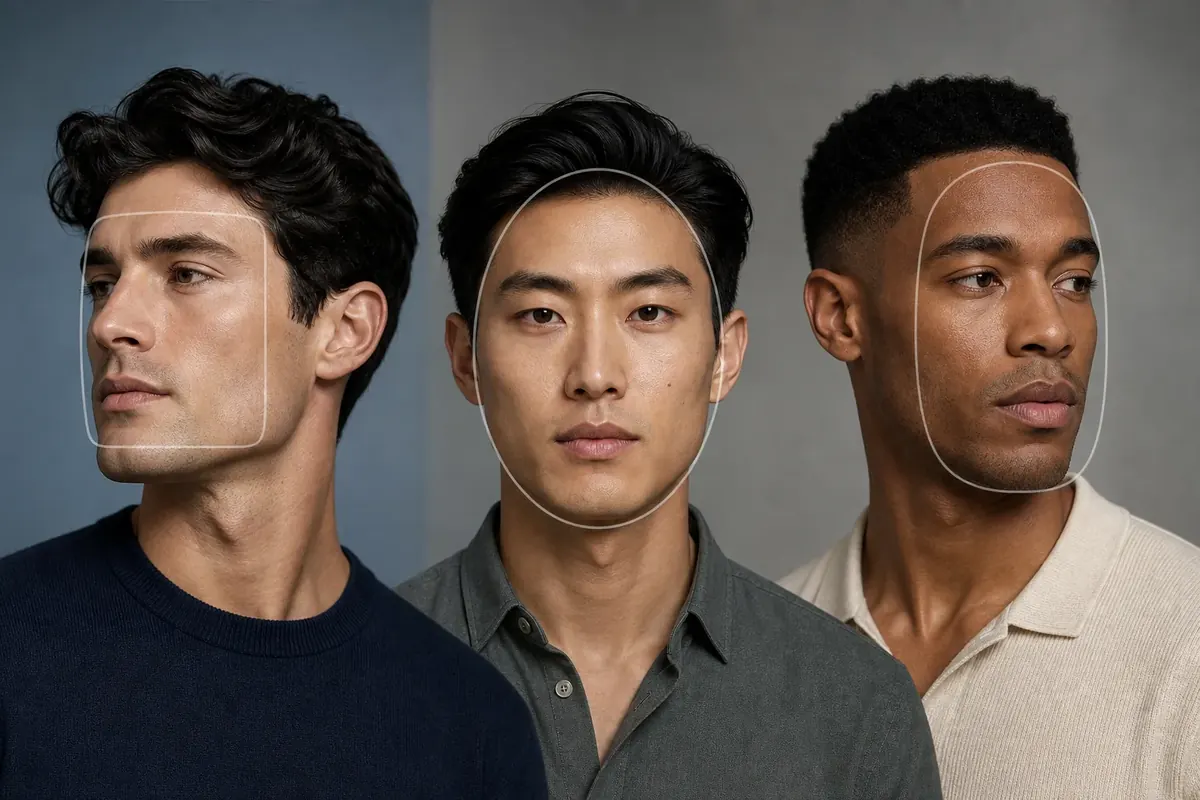
Searches for face shapes men often lead to two extremes: a generic chart that names several types, or a haircut list that assumes the reader already knows his proportions. A more useful approach connects the two. First identify the widest and longest parts of the face, then decide what you want your hairstyle, beard, or glasses to do. This guide keeps the measurement logic neutral while explaining the styling decisions that men usually need next.
How to Read Face Shapes on Men
Men’s faces are not classified by one landmark. A strong jaw can appear in a square, oval, or oblong outline; facial hair can also change the lower-face silhouette. Look at the full outline before choosing a category.
- Start with length: Compare the distance from the center of the hairline to the chin with the widest horizontal part of the face. A clearly longer outline points toward oblong or rectangle; a closer ratio may sit nearer round or square.
- Find the widest area: Notice whether the forehead, cheekbones, or jaw appears widest. The answer matters more than a single mirror impression because it tells you where visual weight already sits.
- Check the jaw and chin: A broad angular jaw often supports a square reading, while a tapered chin can point toward heart or diamond. Softness and angles matter alongside width.
- Separate face shape from style: A fade, beard, fringe, or camera angle can change the apparent outline. Judge the underlying proportions first, then use styling to add or reduce emphasis.
Measure Four Useful Points Before You Choose a Style
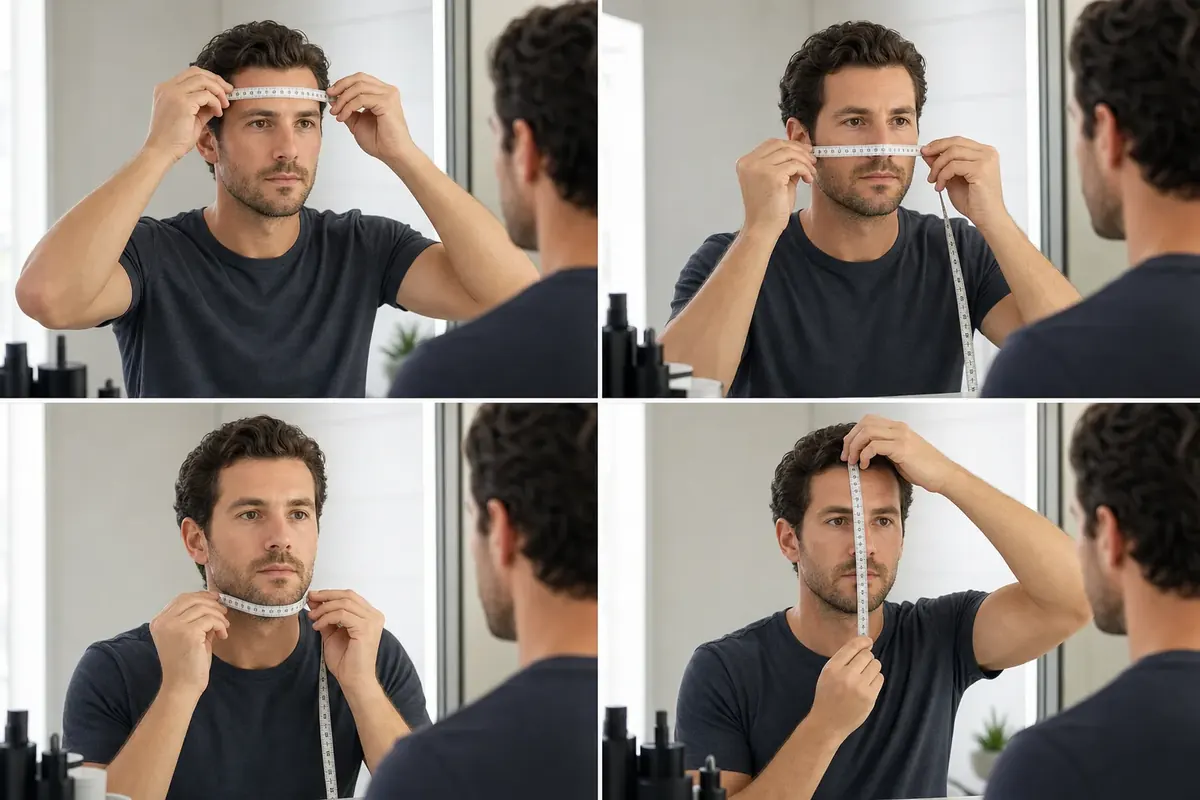
If two face shapes look close, a simple measurement check is more reliable than guessing from a single selfie. Use a soft tape, keep your head level, pull hair away from the outline, and record every measurement in centimeters or inches without mixing units.
- Face length: Measure from the center of the hairline to the tip of the chin. If the hairline is difficult to see, note that the estimate is approximate rather than treating it as an exact boundary.
- Forehead width: Measure across the broadest visible part of the forehead, usually above the eyebrows and below the hairline. Do not wrap the tape around the head; keep the comparison consistent.
- Cheekbone width: Measure between the most prominent points of the cheekbones. This is often the widest point for diamond or some oval outlines, but it should be compared with the jaw rather than read alone.
- Jawline width: Measure from one jaw angle to the other, or measure from the chin to one jaw angle and double it. Use the same method each time because the two methods are not interchangeable.
Seven Face Shapes Men Commonly Compare
The table is a practical comparison, not a ranking. Many men sit between two patterns, and the most useful result may be a combination such as oval-oblong or square-round. Use the closest pattern to guide styling decisions, then check your result with a clear photo or a second measurement.
| Face shape | What to compare | Useful styling direction |
|---|---|---|
| OvalBalanced | Longer than wide; gentle taper | Most styles can work; adapt to texture |
| RoundSoft | Similar length and width | Controlled height and clearer angles |
| SquareStructured | Similar widths and strong jaw | Texture or softness around the outline |
| OblongLong | Length clearly dominates | Side width, fringe, moderate crown height |
| HeartUpper-wide | Wider upper face, tapered chin | Reduce top heaviness; balance below |
| DiamondCheekbone-wide | Cheekbones are widest | Soften cheek emphasis; add gentle balance |
| TriangleLower-wide | Jaw is wider than forehead | Open or lift the upper face |
Match Hair, Beard, and Glasses to the Proportion
The goal is not to hide your face. It is to decide where you want more width, height, softness, or structure. A useful men’s face-shape guide therefore gives directions instead of pretending that one named haircut is correct for everyone.
Hair: control the widest and longest areas
For a round face, modest height and defined texture can add length without making the sides wider. For an oblong face, side movement or a lower fringe can interrupt vertical length. For a square face, textured movement can soften the outline, while an oval face can usually handle more variation. These are starting directions; your hairline and density decide the final cut.
Beard: treat it as part of the outline
A beard changes the apparent width and length of the lower face. Extra length at the chin can make an already-long face look longer, while a carefully tapered beard can add definition to a round outline. A strong jaw does not automatically require a heavy beard; keep the beard goal aligned with the proportion you want to balance.
Glasses: compare frame width and shape
Frames add a new horizontal or angular line across the face. Men with a longer outline may prefer frames with enough height and width to create balance, while round outlines often respond well to clearer angles. Fit, bridge position, lens height, and personal prescription matter more than a rigid shape rule.
Style goal: describe the effect to a barber
Instead of asking only for a haircut name, say what you want to change: less height, more side width, softer jaw emphasis, a cleaner cheek line, or a fringe that shortens the visual length. This turns face-shape information into a useful salon conversation.

Adjust for Hair Texture, Hairline, and Daily Routine
Two men can share the same face shape and still need different cuts. Hair texture and real-life maintenance decide whether a style will keep its intended balance after the salon visit.
- Straight and fine hair: Avoid relying on tall volume that collapses quickly. Light texture, a controlled side part, or a modest fringe can create shape without demanding constant product.
- Thick or wavy hair: Remove weight where the hair expands too much, but keep enough movement to avoid a solid helmet effect. Side volume can be useful when it is shaped rather than left bulky.
- Curly or coily hair: Plan with shrinkage and natural width in mind. The best balance may come from controlling the outline while preserving curl pattern instead of forcing the hair flat.
- Receding hairline or thinning crown: A face-shape label should not override the hairline. Ask for a cut that works with the direction of growth, and avoid a style that requires unrealistic density or height.
Common Mistakes When Men Judge Face Shape
The fastest way to get a confusing result is to treat a photo, haircut, or celebrity comparison as a measurement. Use these checks before changing your style.
- Using a wide-angle selfie: A close phone camera can enlarge the center of the face and change the apparent jaw or forehead width. Use a camera farther away at eye level when checking proportions.
- Measuring over hair or beard: Hair volume and a full beard are styling signals, not facial landmarks. Move hair back and compare the underlying outline before deciding.
- Assuming a strong jaw means square: Jaw strength can appear in several shapes. Compare face length and the relative width of the forehead, cheekbones, and jaw before choosing square.
- Treating one result as permanent: Weight changes, hairline changes, facial hair, and camera conditions can alter the visible impression. A close result is normal, not a tool failure.
- Choosing a haircut before choosing a goal: A named style may look different on different hair textures. Decide whether you want to add width, reduce length, soften angles, or highlight structure first.
A Simple Ten-Minute Face Shape Workflow for Men
Use this process before a haircut, new glasses, or a beard change. It combines a quick visual check with enough detail to avoid overconfident guesses.
- Take one neutral photo: Stand in even light, keep the camera at eye level, and leave enough distance to reduce lens distortion.
- Clear the outline: Pull hair away from the forehead and jaw, and note whether facial hair is changing the outline you are trying to judge.
- Record the four measurements: Write down face length, forehead width, cheekbone width, and jawline width in one unit.
- Compare the widest area: Decide whether the upper face, cheekbones, or jaw carries the most width, then compare that with overall length.
- Choose one balance goal: Pick a practical direction such as more side width, less height, softer jaw emphasis, or clearer angles.
- Take the result to a professional: Show the photo and describe the balance goal to your barber, stylist, or optician instead of relying on the label alone.
What to Do With Your Result
Once you have a likely face shape, use it to narrow choices rather than to eliminate them. The most useful next step depends on what you are deciding today.
If you want a more transparent answer
Use the face shape calculator to compare the four measurements and see why a result leans toward one shape. This is especially helpful when oval and oblong, or round and square, look close.
If you want a photo-based estimate
Use the detector with a clear front-facing photo and compare more than one image. A consistent pattern is more useful than a single label from a difficult angle.
If you are choosing a haircut
Move from the general shape to a dedicated hairstyle guide for the specific proportion. Bring the balance goal, hair texture, and maintenance time to the consultation.
If you are choosing glasses
Use the shape as a frame-selection starting point, then prioritize fit, bridge comfort, lens height, and how the frame sits on your actual face.
Face Shapes for Men FAQ
Technical reference
- Google AI Edge Face Landmarker — Background on facial-landmark-based analysis; this guide is for styling decisions, not medical diagnosis.
Last updated: August 2, 2026