How to Identify Face Shape by Measurement
A repeatable way to measure four facial points, compare proportions, and handle close results without forcing one label.

On this page
If you are searching for how to identify face shape, start with a repeatable measurement rather than a hairstyle, a celebrity comparison, or one close selfie. Face shape describes the outline created by length, forehead, cheekbones, jaw, and chin. This guide keeps the task practical: use the same view, record four numbers, compare their relationships, and keep a second pattern when the result is close.
How to Identify Face Shape: Start With Four Measurements
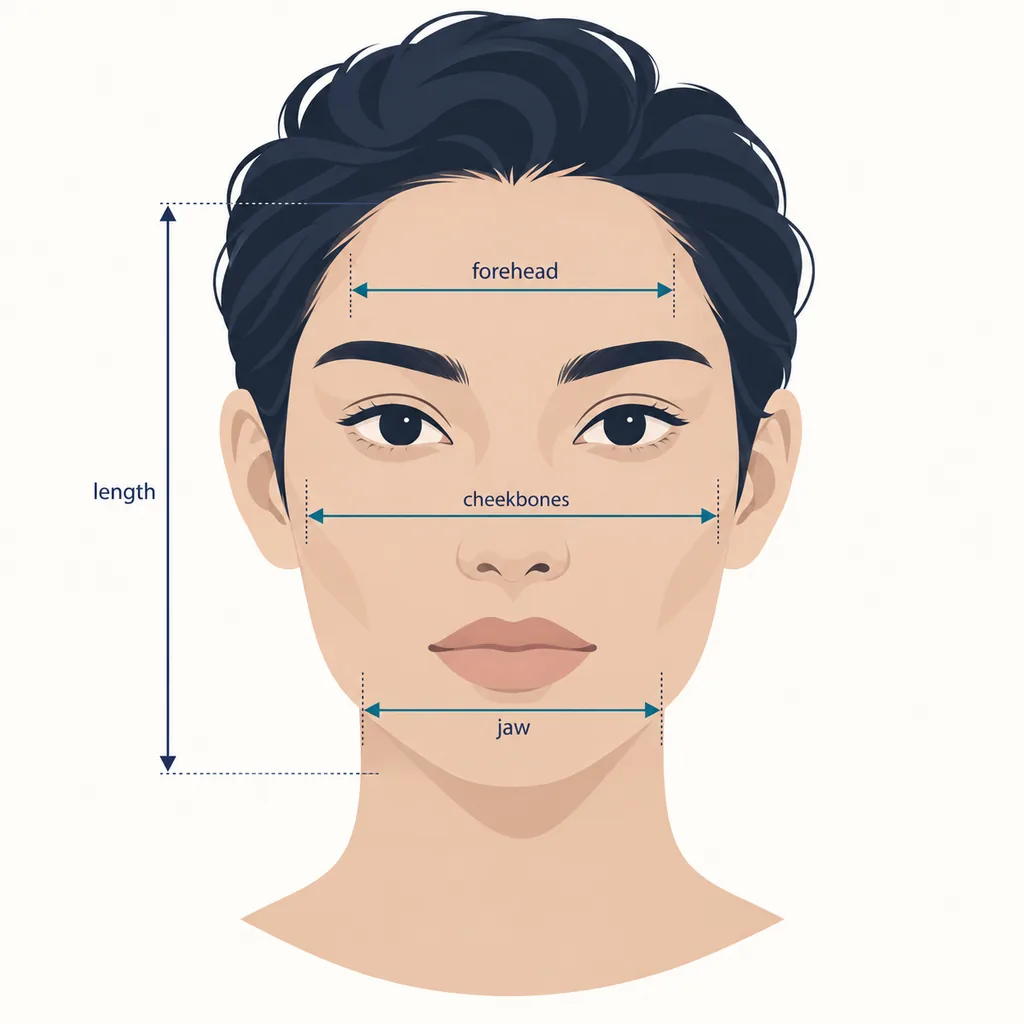
The most useful manual method compares four areas. You do not need laboratory precision. Consistent points and a calm, front-facing view are more valuable than a number that looks exact but was taken from a tilted head.
- Face length: Measure from the center of the hairline area to the lowest point of the chin. This tells you whether the face reads longer than wide or closer to balanced.
- Forehead width: Record the widest horizontal distance across the forehead, usually above the eyebrows. Compare it with the cheekbones and jaw rather than judging it alone.
- Cheekbone width: Measure across the most prominent points of the upper cheeks. This often identifies the widest zone and helps separate diamond, oval, and heart patterns.
- Jaw width and outline: Measure the jaw at its broadest visible span and describe whether it looks rounded, straight, broad, tapered, or pointed. The outline matters as much as the width.
Prepare a Reliable Measurement or Photo
Before you identify face shape, remove avoidable sources of distortion. A flexible tape, ruler, or a marked photo can work. The goal is to compare the same landmarks from the same viewing angle.
- Clear the outline: Pull hair away from the forehead and jaw, remove large glasses for the first pass, and use a neutral expression. Hair volume can make the face look wider or longer than it is.
- Use soft, even light: Face a window or a shaded light source. Strong side light creates a false jaw shadow, while backlight hides the outline. Avoid filters that reshape or smooth the face.
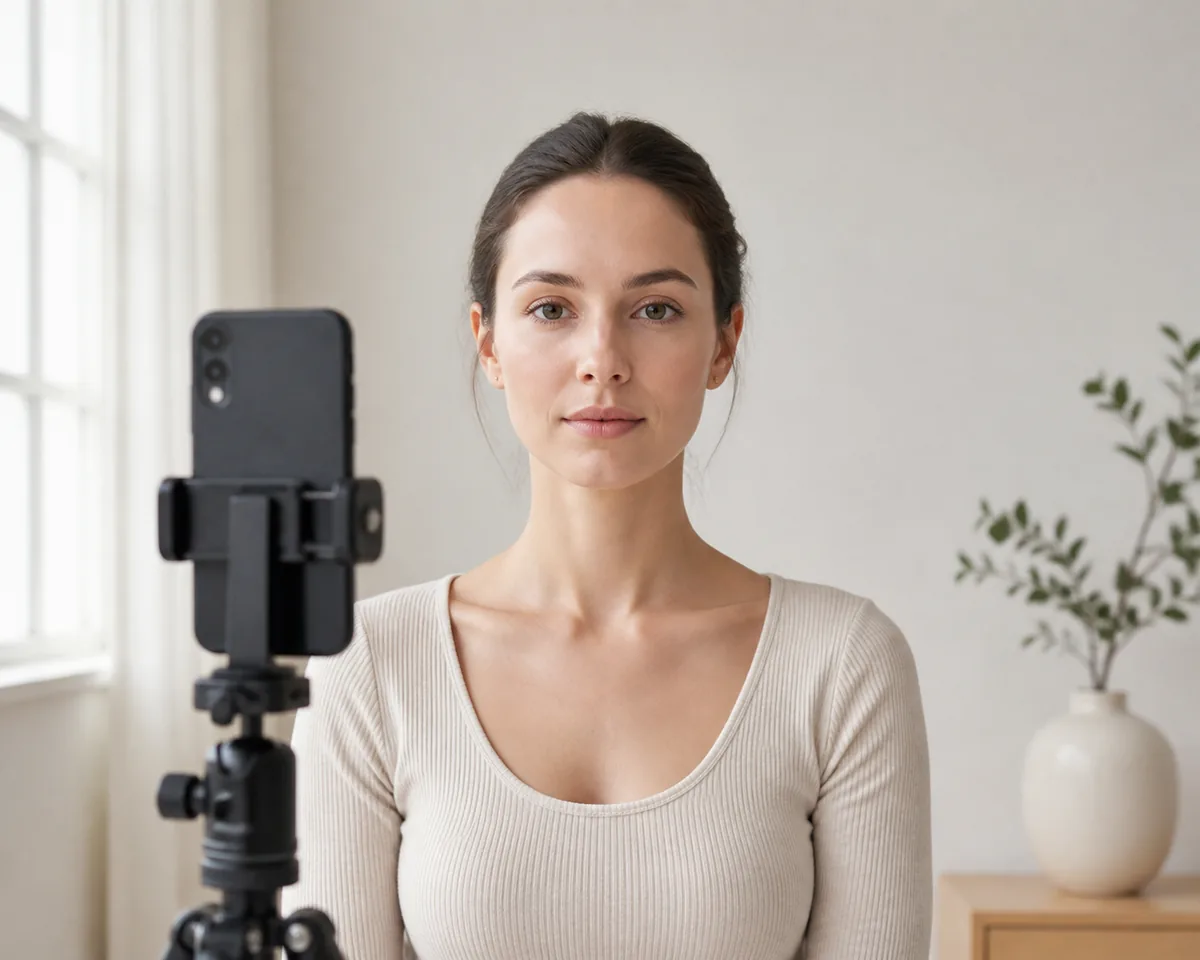
- Keep the camera level: Place the lens at eye height, keep it straight ahead, and stand far enough away that the phone does not use an extreme wide-angle view. A mirror is fine if your head stays level.
- Choose one unit: Use centimeters or inches for every point. Round each value to the nearest millimeter or eighth of an inch, then repeat a measurement if the tape slips.
Measure Face Length, Forehead, Cheekbones, and Jaw
Write the four values in a small note before interpreting them. Measure on the skin or on a straight-on image with the same scale. Do not mix a close selfie measurement with a distant portrait measurement.
| Point | Where to measure | Why it helps | Unit |
|---|---|---|---|
| Face length | Hairline area to the lowest point of the chin | Separates balanced faces from longer oval or oblong patterns | cm or in |
| Forehead | Widest straight line above the eyebrows | Shows whether the upper face is broad, balanced, or narrow | cm or in |
| Cheekbones | Straight line between the most prominent upper-cheek points | Finds the widest zone and highlights diamond or oval cues | cm or in |
| Jaw | Broadest span from one jaw corner to the other | Separates rounded, square, tapered, and triangle-like outlines | cm or in |
- Measure face length: Start at the center of the upper face or hairline area and finish at the bottom of the chin. If the hairline is unclear, mark the top of the visible forehead and note that the value is approximate.
- Measure the forehead: Find the widest horizontal line across the forehead, often between the temple areas. Keep the tape flat and do not follow the curve around the head.
- Measure the cheekbones: Locate the most prominent points below the outer eye corners. Measure straight across those points. This is a width, not the distance around the cheeks.
- Measure the jaw: Use the broadest visible jaw span, or measure from one jaw corner to the other on a photo. Add a note about the contour: rounded, angular, straight, tapered, or pointed.
Turn the Numbers Into a Face-Shape Pattern
Numbers narrow the options, but they do not replace the outline. Compare the length with the largest width first, then compare the forehead and jaw. When two patterns fit, keep both and explain which signal made one more likely.
A simple ratio check
Length-to-width ratio = face length ÷ the widest horizontal measurement. A noticeably higher ratio suggests an oblong or oval direction; a ratio close to 1 suggests round or square possibilities. Use the ratio as a clue, not a hard cutoff.
- Find the widest zone: If cheekbones clearly exceed forehead and jaw, compare diamond and oval. If the forehead is widest and the chin narrows, compare heart. If the jaw is widest, compare triangle or a broad square.
- Check softness versus angles: A rounded jaw and soft sides support round or oval. Straighter sides and a defined jaw support square or oblong. Lighting can make a soft jaw look sharper, so check the photo and mirror together.
- Use the chin as a tie-breaker: A pointed or narrow chin supports heart or diamond; a broad lower face supports square or triangle. A small chin difference should not outweigh a clear length pattern.
- Keep a close second: Oval and oblong, heart and diamond, and round and soft square often overlap. Reporting a primary pattern plus a close second is more honest than pretending every face fits one box.
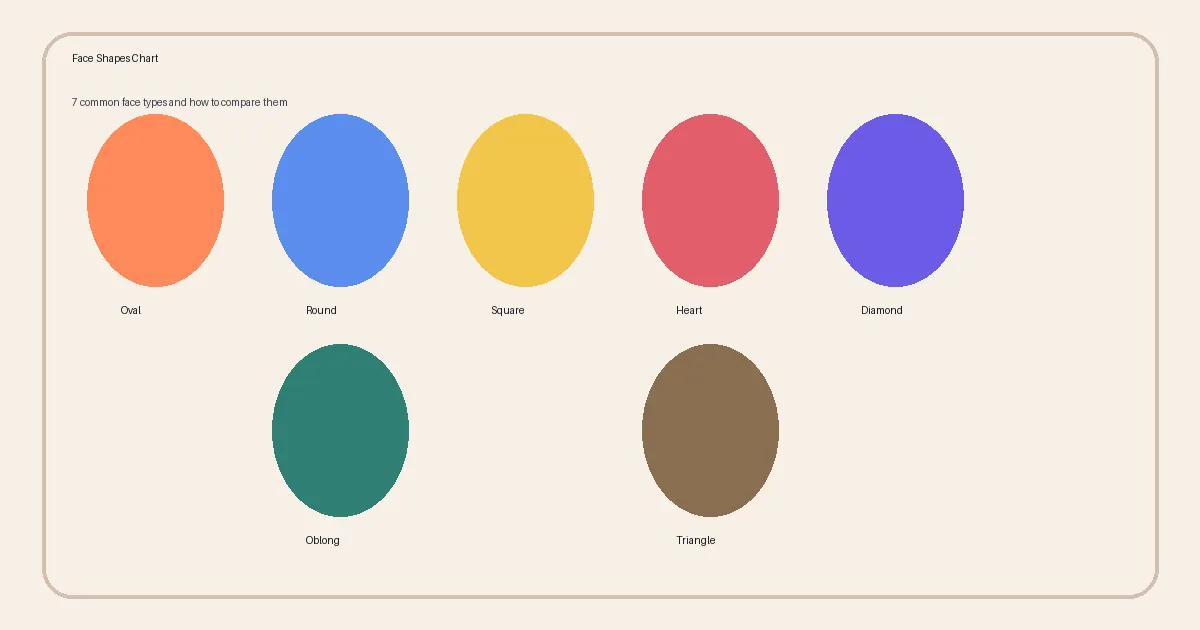
Compare the Seven Common Face-Shape Patterns
Use this table after measuring. The descriptions are practical pattern cues, not rules about attractiveness, gender, weight, or which styles you are allowed to wear.
| Pattern | Signals to compare | Often confused with |
|---|---|---|
| Oval | Longer than wide, gently curved jaw, forehead a little wider than chin | Oblong when length is strong; round when length is subtle |
| Round | Length and width feel close, cheeks look full, few hard angles | Soft square |
| Square | Forehead and jaw are broad with straighter sides and clear corners | Round under soft light |
| Heart | Upper face is broad and the chin narrows or points | Diamond when cheekbones are the true widest point |
| Diamond | Cheekbones are widest with a narrower forehead and chin | Heart |
| Oblong | Length is clearly greater than width while zones remain fairly even | Oval |
| Triangle | Forehead is narrower and the jaw or lower face is wider | Heart when the chin tapers |
Work Through a Measurement Example
Suppose a neutral photo gives a face length of 19 cm, a forehead of 15 cm, cheekbones of 16 cm, and jaw of 14 cm. The widest point is the cheekbones, and the length-to-width ratio is 19 ÷ 16 = 1.19. That points toward an oval or soft diamond reading, not a certain diagnosis.
| Measurement | Example | What it suggests |
|---|---|---|
| Face length | 19 cm | A longer vertical line |
| Forehead | 15 cm | Narrower than cheekbones |
| Cheekbones | 16 cm | Widest zone |
| Jaw | 14 cm | Tapered lower outline |
Explain the strongest signal
The face is longer than wide, but not dramatically long. Cheekbones are the widest area, while the forehead and jaw are narrower. That combination supports oval first and diamond as a close comparison.
Test the result
Repeat the measurement on a level photo. If a small change moves the jaw or cheekbone value by one centimeter, keep the result as a range and use a face shape calculator or photo detector only as a second opinion.
Common Measurement Mistakes and Limits
When two tools disagree, the cause is often a different input view or a different classification rule. A careful method should make those limits visible instead of promising perfect accuracy.
Using a close wide-angle selfie
A phone held very close enlarges the center of the face and can make the jaw look narrower. Use a level portrait taken from farther away or measure a printed image with a known scale.
Measuring around a curve
Forehead, cheekbone, and jaw values should be straight horizontal spans. Wrapping the tape around the head produces a larger number that cannot be compared with a flat photo measurement.
Letting hair set the boundary
Bangs, a high bun, or thick side hair can hide the real outline. Tie hair back for measurement, then release it when you decide how a style looks in daily life.
Treating a category as a verdict
Face shape is a styling reference, not a beauty score or a medical finding. Face position, expression, aging, glasses, and camera choice can all change the visible pattern.
Choose a Useful Next Step
After you identify face shape by measurement, use the result for a practical decision. Keep the numbers, the photo conditions, and the close second pattern so you can revisit the conclusion later.
Use a calculator for a structured check
If you have approximate values, the face shape calculator can organize the four inputs and show which relationship is driving the result. Treat the output as an explanation aid, not a replacement for judgment.
Use a photo detector as a second opinion
A clear front-facing image can provide a fast estimate. Compare it with the measured pattern and investigate a disagreement by checking light, lens distance, hair, and expression.
Apply the category flexibly
Use face shape to generate ideas for frames, hair, or makeup, then prioritize fit, comfort, texture, and personal preference. A close result is still useful when it guides a small experiment.
FAQ: How to Identify Face Shape by Measurement
Related face-shape guides and tools
- What face shape do I have? - Start with a quick category explanation before measuring.
- Face shapes chart - Compare seven common patterns in one reference table.
- Face shape calculator - Organize approximate measurements and review the result.
- Free face shape detector - Get a photo-based estimate from a clear front-facing image.
- How to find your face shape - Compare mirror, photo, and tool-based methods.
Last updated: November 16, 2026