Oval Face Shape: How to Identify It and Choose What Suits It
A practical guide to oval face proportions, manual measurements, nearby face-shape differences, hairstyles, glasses, and common identification mistakes.

Contents
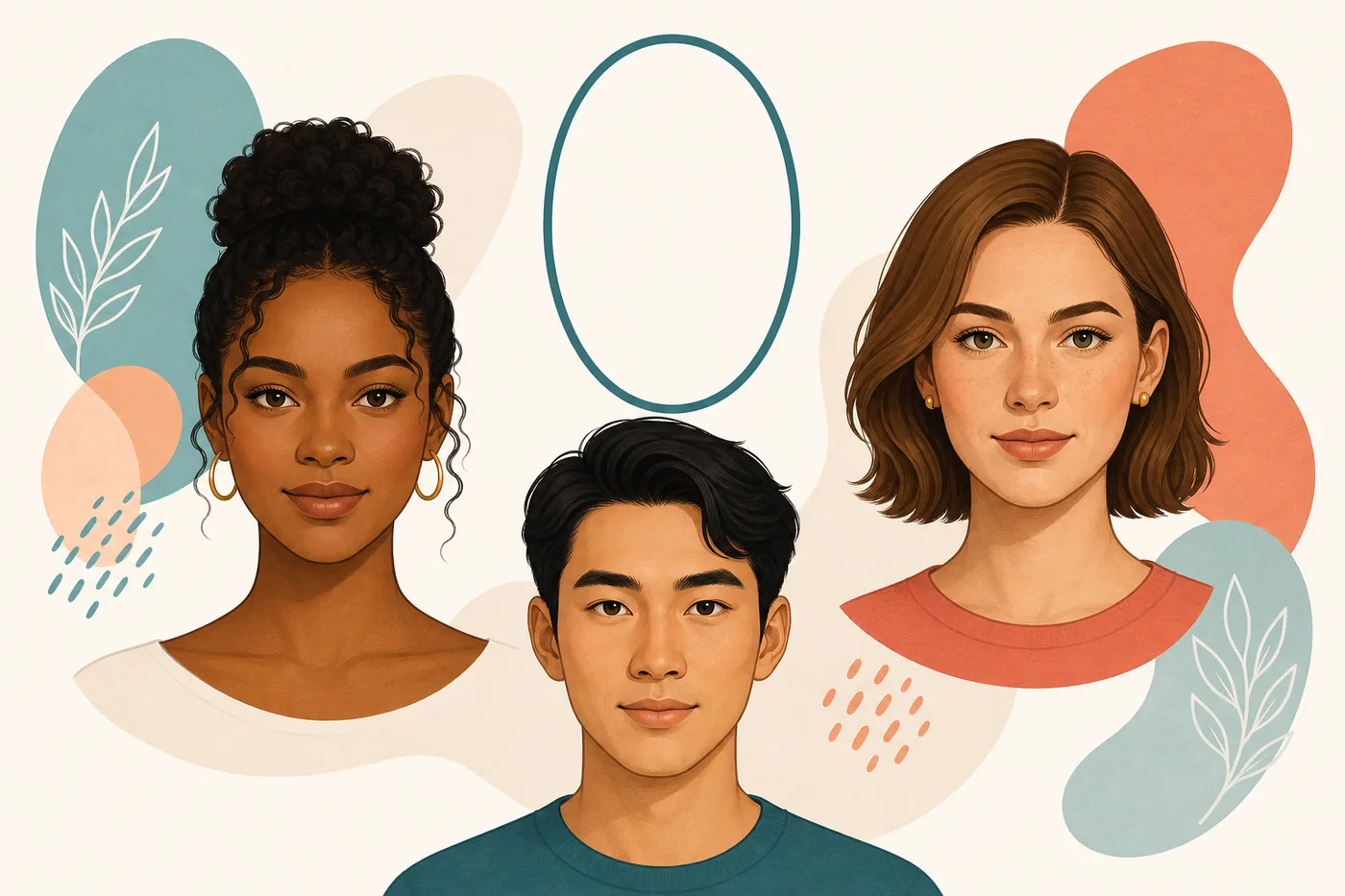
The oval face shape is often described as balanced because no single width or angle dominates the outline. That description is useful, but it can also lead to overconfident guesses: a short oval may be called round, while a long oval may be mistaken for oblong. The reliable approach is to compare face length, cheekbone width, forehead width, jaw width, and the curvature of the sides together. This guide helps you make that comparison, then use the result as a flexible styling reference—not a rule about what you are allowed to wear.
5 signs of an oval face shape
Look for a group of features rather than a perfect geometric oval. Real faces are asymmetrical, hairlines vary, and soft tissue changes how the outline appears. An oval classification is most useful when these five clues point in the same direction.
- More length than width: The face reads vertically longer than the widest cheekbone span, but it does not look extremely narrow or stretched.
- Cheekbones lead the outline: The broadest area is commonly around the cheekbones, with a gentle narrowing above and below.
- Forehead and jaw stay balanced: The forehead is often a little wider than the jaw, without the dramatic taper of a heart-shaped face.
- Soft jaw and chin: The lower face curves into a rounded or lightly tapered chin instead of forming square corners or a sharp point.
- Curved side profile: From temples to jaw, the outline changes width gradually rather than running in long, nearly parallel lines.
Use the outline, not a beauty ideal
Oval is a proportion category, not a score for symmetry or attractiveness. A face can have an oval outline with a strong nose, full cheeks, a high forehead, a defined jaw, or visible asymmetry. Classify the outer geometry first, then consider individual features for styling decisions.
How to measure an oval face shape at home
Take measurements from a neutral, front-facing photo or in a mirror with your hair pulled away from the hairline and jaw. Keep the tape flat rather than following the curve of the skin. The numbers are a screening aid: camera distance, lens distortion, hairline shape, and where you place the tape can all change the result.
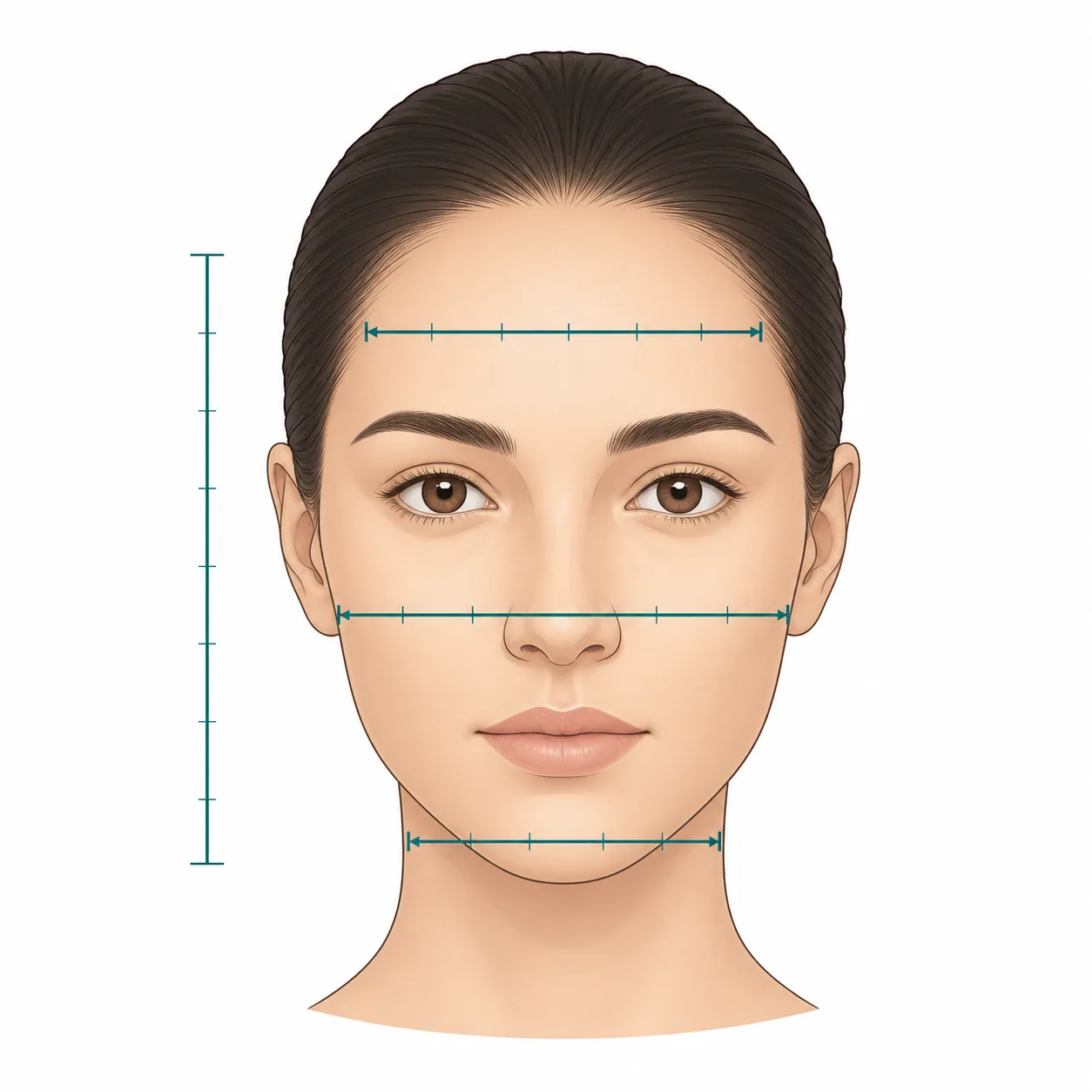
Measure four areas from a straight-on view, then interpret the pattern instead of relying on one number.
- Prepare a straight-on view: Use even lighting, a neutral expression, an eye-level camera, and enough distance to avoid wide-angle selfie distortion. Remove glasses and keep hair away from the outline.
- Measure face length: Measure from the center of the visible hairline to the lowest point of the chin. If your hairline is irregular, use the point that best represents its central boundary.
- Measure cheekbone width: Measure between the outermost visible points of the cheekbones, usually below the outer corners of the eyes. This is often the widest oval-face measurement.
- Compare forehead and jaw: Measure the forehead at its broadest useful point and the jaw across the widest corners. An oval face usually narrows gradually toward the jaw.
- Check curves and ratios together: A face that is clearly longer than wide, widest near the cheekbones, and softly tapered at the jaw is a stronger oval match than a face that only satisfies one numerical ratio.
Many style guides use a length-to-width ratio around 1.3:1 to 1.5:1 as an oval clue, but there is no universal diagnostic cutoff. Treat the ratio as one signal. If the horizontal widths remain similar from forehead to jaw and the sides look straighter, oblong may fit better; if length and width are close, compare oval with round.
Oval vs round, oblong, and diamond face shapes
The most useful comparison is not which label looks closest in an illustration, but which measurement changes explain your own outline. Oval and round share soft jaws; oval and oblong share extra length; oval and diamond can both be widest at the cheekbones. The table isolates the deciding clue for each pair.
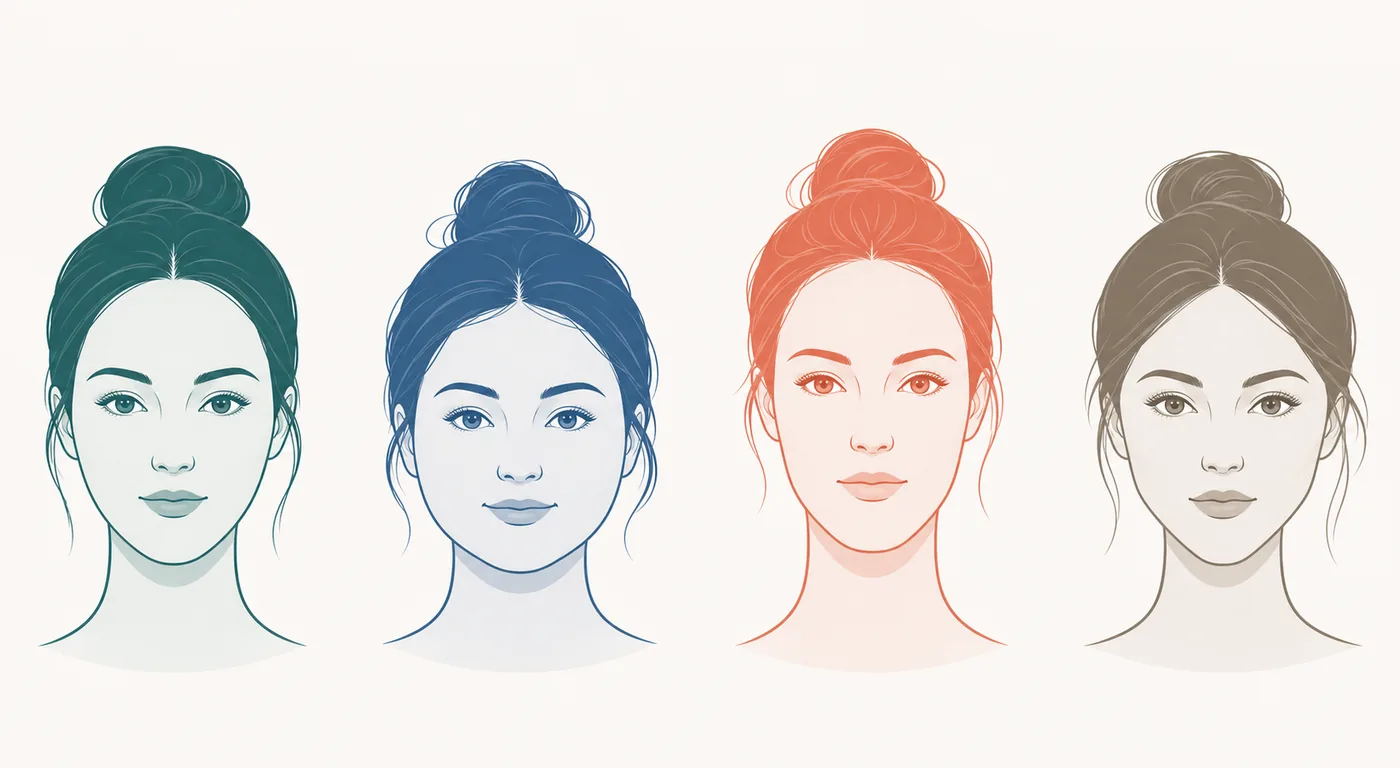
From left: oval, round, oblong, and diamond. Compare length, side curvature, and the widest point.
| Shape | Proportion | Jaw and sides | Deciding clue |
|---|---|---|---|
| Oval | Longer than wide | Soft taper; curved sides | Cheekbones lead without extreme length |
| Round | Length and width are closer | Soft, broad curve | Less vertical length than oval |
| Oblong | Noticeably long | Soft or angular; straighter sides | Forehead, cheeks, and jaw stay more uniform |
| Diamond | Often longer than wide | Narrower, sometimes pointed | Cheekbones contrast strongly with forehead and jaw |
Hairstyles, glasses, and styling for an oval face
Because an oval face already has gradual curves and balanced widths, styling usually works best when it preserves scale rather than trying to correct the face. Hair texture, density, frame fit, bridge position, and personal taste matter more than a generic list of approved shapes. Use the suggestions below as starting points for proportions.
Hairstyles: control length and keep useful movement
Most short, medium, and long cuts can work on an oval face. The more important question is whether the haircut makes an already long face look unnecessarily stretched. Face-framing layers, bobs, textured crops, side parts, waves, pixies, and medium flow all provide shape without hiding the natural outline. If your oval leans long, avoid combining very flat sides with extreme height on top. If it leans short, moderate crown volume can feel balanced.
- Place layers near the cheekbones or jaw to create movement at a useful width.
- Choose fringe according to forehead height and hair texture, not because every oval face needs or avoids bangs.
- For detailed male haircut choices, use the dedicated oval face shape hairstyles for men guide.
Glasses: fit and scale before frame shape
Oval faces can usually wear angular, round, aviator, browline, or subtle cat-eye frames because the outline does not need a strong counter-shape. Start with physical fit: pupils should sit comfortably within the lenses, the bridge should not pinch or slide, and the frame width should relate to the widest part of the face. Very narrow frames may make the face look longer, while oversized frames can cover the eyebrows or rest on the cheeks.
- Try frames as wide as, or slightly wider than, the cheekbone area.
- Use angular frames for more definition and rounded frames for a softer effect.
- Check lens height and bridge fit in profile; face-shape advice cannot fix a poorly fitting frame.
Makeup, facial hair, and accessories
Styling can emphasize features without pretending to change bone structure. Blush placed toward the upper cheek can highlight cheekbones; a beard can add more lower-face definition; earrings can introduce either clean angles or repeated curves. The useful choice depends on the effect you want. Someone with an oval face and a prominent forehead may make different decisions from someone with the same outline and a shorter forehead.
- Keep contour subtle and follow real shadows rather than drawing a new face shape.
- Shape facial hair around growth pattern and jaw definition, not an assumed gender rule.
- Choose accessory scale in relation to neck length, hairstyle, and frame size as well as face outline.
Common oval face identification mistakes
Most wrong classifications come from the photo or from forcing a single measurement to decide the answer. Borderline faces are normal, and a primary shape plus a secondary influence is often more useful than pretending every feature matches one category.
- Calling every long face oval: An oblong face is also long, but often has straighter sides and more similar forehead, cheekbone, and jaw widths.
- Calling every soft face round: Full cheeks do not determine face shape. Compare total length with cheekbone width and inspect how the jaw tapers.
- Using a close selfie: A wide-angle phone camera can enlarge the center of the face and change the apparent width of the jaw and forehead.
- Treating ratios as clinical facts: Face-shape ratios are styling heuristics, not medical diagnoses. Different guides use different landmarks and thresholds.
- Ignoring mixed features: You may have an oval outline with a square jaw influence or diamond-like cheekbones. Use the secondary feature when choosing hair or frames.
Oval face shape FAQ
How can I tell if my face is oval or round?
Compare face length with cheekbone width. An oval face is visibly longer than wide and usually tapers softly toward the jaw; a round face has length and width that are closer, with a broader continuous curve. Use a straight-on photo because angled selfies can make both shapes look narrower.
What is the difference between an oval and oblong face?
Both are longer than wide. Oval faces usually widen around the cheekbones and curve gradually toward a narrower jaw. Oblong faces tend to look longer, with straighter sides and forehead, cheekbone, and jaw widths that remain more similar.
What hairstyles suit an oval face shape?
Most haircut families can suit an oval face. Choose according to hair texture, maintenance, and whether your face leans short or long. Layers, bobs, textured crops, side parts, waves, pixies, and medium-length flow are useful starting points; avoid excessive height only when it makes the face look longer than you prefer.
What glasses look best on an oval face?
Oval faces can work with many frame shapes, including rectangular, round, aviator, browline, and cat-eye. Prioritize frame width, bridge comfort, pupil position, and lens height. A well-fitting frame in a style you like is more important than following a strict shape rule.
Can men and women use the same oval face measurements?
Yes. The measurement method is based on outline proportions, not gender. Hairstyle, facial hair, brow shape, and styling preferences can change the visual effect, but the same length, cheekbone, forehead, jaw, and curvature checks apply.
References and measurement context
Face-shape systems are styling frameworks rather than medical standards. These resources provide broader face-shape and eyewear context; the ratio guidance in this article is deliberately presented as a heuristic.