Haarschnitt für Männer mit Rundem Gesicht: Schnitte mit mehr Kontur
Praktischer Guide für Männerfrisuren bei rundem Gesicht: strukturierter Crop, Fade, Quiff, Seitenscheitel, Curly Taper und klare Anweisungen für den Barber.

Inhaltsverzeichnis
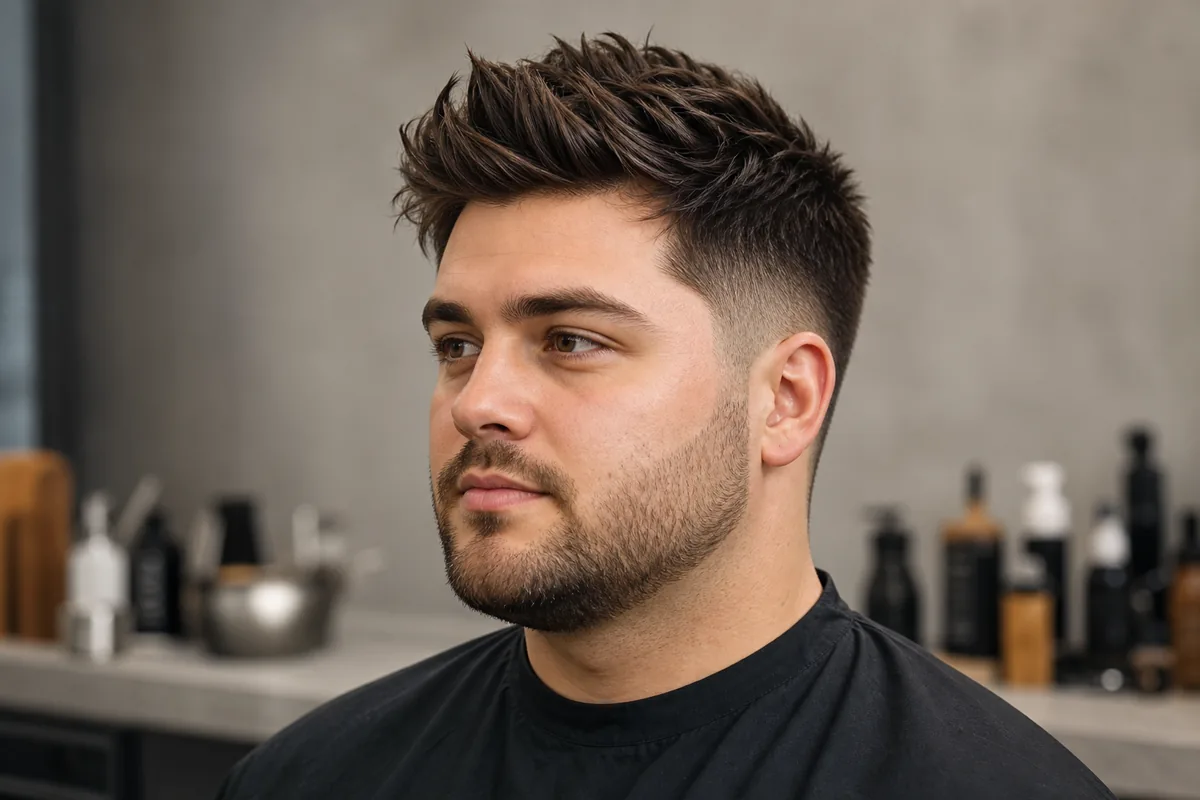
Ein rundes Gesicht wirkt offen und sympathisch, kann mit dem falschen Schnitt aber breiter erscheinen. Dieser Guide erklärt nicht nur Namen, sondern die Form dahinter: Höhe, klare Seiten, Winkel und realistische Pflege.
Warum ein rundes Gesicht Struktur braucht
Finde den besten Haarschnitt für Männer mit rundem Gesicht: Frisuren nach Haartyp, Fehler, Barber-Anweisungen und Gesichtsform-Check.
- Height helps, but only when controlled: A little lift at the front or crown lengthens the face visually. Too much height can look forced, so the goal is controlled volume rather than a tall wall of hair.
- Clean sides reduce extra width: Tapered or faded sides stop the haircut from expanding around the cheeks, which is where many round faces already look widest.
- Texture creates angles: Choppy texture, a side part, a brushed-up front, or a defined curl pattern gives the eye lines to follow instead of one soft circle.
- The beard line matters: If you wear facial hair, a neat beard can sharpen the jaw. A rounded full beard that bulks at the cheeks can make the face look even rounder.
Stylist rule
For round face haircuts, think taller on top, tighter at the sides, and sharper around the temples or jaw. Avoid adding volume directly beside the cheeks.
Beste Haarschnitte für Männer mit rundem Gesicht
Use this table as a barber brief. The same haircut name can look different depending on fade height, top length, texture, and styling product, so focus on the shape you want to create.
| Haircut | Why it works | What to ask your barber | Best for |
|---|---|---|---|
| Textured crop with fadeModern and low effort | Texture breaks up softness while the fade keeps cheek width controlled. | Short textured top, soft or angled fringe, low or mid fade, no bulky sides. | Straight or thick hair, easy daily styling. |
| Ivy LeagueClean and versatile | The short side part gives structure without making the haircut too sharp. | Scissor top long enough to part, tapered sides, natural front lift. | Work settings, fine to medium hair. |
| Controlled quiffHeight without width | Moderate lift lengthens the face while the sides stay tight. | Medium top, blended sides, textured front, avoid extreme height. | Thick hair, social or polished style. |
| Faux hawk taperSharper center line | The eye follows the center height instead of the cheek width. | Textured center, tapered sides, keep the shape wearable rather than spiky all over. | Younger or casual style, medium to thick hair. |
| Side part fadeClassic structure | A diagonal part adds angles and makes the face look less circular. | Natural side part, low or mid fade, top styled slightly up and across. | Straight, wavy, or business-friendly haircuts. |
| Curly taperDefined curls, clean outline | Curls stay expressive on top while the taper removes roundness at the sides. | Keep curl definition, taper temples and neckline, remove side bulk. | Curly or coily hair. |
| Crew cut with short beardSimple and masculine | A neat beard or stubble can sharpen the jaw when the haircut is very short. | Short top, clean taper, keep beard line squared rather than rounded. | Thin hair, active routines, minimal styling. |
Nach Haartyp auswählen
The right shape depends on your hair's density and movement. A style that works on thick straight hair may collapse on fine hair or become too wide on curls, so adjust the cut before you copy a reference photo.
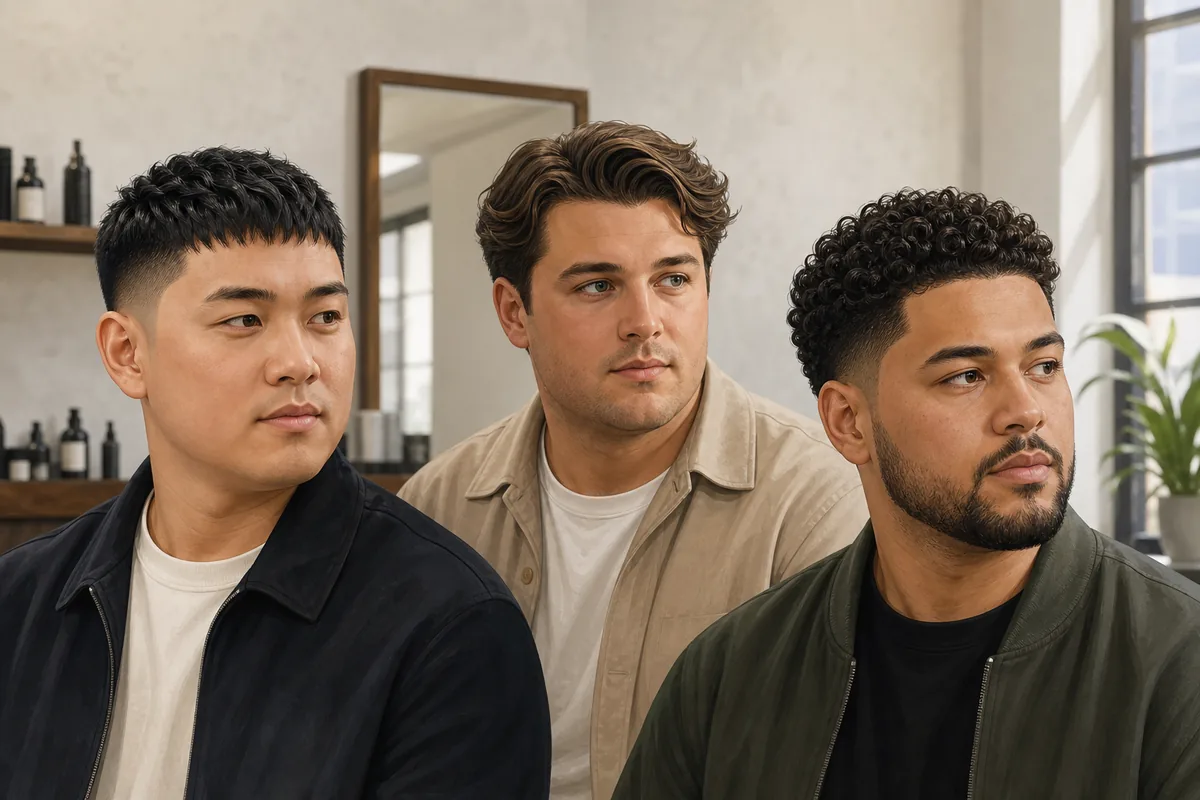
Different hair textures need different shape control: straight hair needs texture, waves need side control, and curls need a clean taper.
Straight hair
Straight hair can look flat at the roots, so the haircut should build texture and direction.
- Ask for a textured crop, Ivy League, or short quiff if you want lift without heavy styling.
- Use matte clay or paste so the hair keeps separation instead of lying flat.
- Avoid a long rounded fringe that sits across the forehead and repeats the face shape.
Wavy hair
Wavy hair is useful for round faces because it can add movement without looking stiff.
- Try a side part, medium textured top, or low fade with natural wave on top.
- Keep side bulk under control around the ears and cheeks.
- Use light cream or sea-salt spray rather than heavy gel.
Curly or coily hair
Curls can add strong shape, but the silhouette must avoid becoming too round at the sides.
- Ask for a curly taper that keeps definition on top and removes width at the temples.
- Keep curl height moderate and shaped forward or upward rather than outward.
- A short boxed beard can add jaw definition if the cheeks look soft.
Thin or receding hair
Thin hair needs a cut that looks intentional without exposing the scalp through over-styling.
- Choose a crew cut, short crop, or Ivy League with a gentle taper.
- Avoid wet-look products because they separate fine hair too much.
- Do not force a high quiff if the front hairline cannot support it.
Thick hair
Thick hair can overwhelm a round face if the sides are left heavy.
- Ask for internal texture, debulking, and a clean taper around the sideburns.
- Keep length on top only where it creates height or direction.
- Book trims before the side volume grows into the cheek area.
Diese Schnitte sind meist ungünstig
Round faces can wear many styles, but a few choices can make the face look wider or softer than it is.
- Heavy rounded fringe: A blunt fringe that curves across the forehead can echo the face shape and shorten the face.
- Wide side volume: Medium-length sides that puff near the cheeks add width exactly where a round face needs control.
- Center part with flat length: Flat curtains can drag the eye sideways and downward if there is no layering or root lift.
- Buzz cut with no beard or edge: A very short uniform cut may work for some men, but it can expose roundness when there is no jawline, temple, or beard definition.
- Overly rounded beard: Facial hair that bulks at the cheeks and rounds under the chin can cancel the structure created by the haircut.
Was du beim Barber sagen solltest
Do not ask only for a haircut name. Bring a reference, then describe how the sides, top, neckline, and styling effort should behave for your face shape.
- Start with the face-shape goal: Say that you want to reduce cheek width and add a little height or angular texture.
- Choose the fade height carefully: Low and mid fades are safer for most round faces. A high skin fade can work, but only if the top has enough shape and the result does not look too severe.
- Keep the top directional: Ask for texture that can be styled up, diagonally, or slightly to the side instead of lying round and flat.
- Control the sideburns and beard line: A sharper sideburn or short boxed beard can add structure near the jaw.
- Discuss styling time: If you have only two minutes in the morning, choose a crop, crew cut, or natural taper instead of a high-maintenance quiff.
Gesichtsform vorher prüfen
A face can look round because of camera angle, hairstyle, weight changes, or a full beard. Check the actual proportions before you commit to a style.
- Compare length and width: Round faces often have similar face length and width, with the widest point near the cheeks.
- Look at the jawline: A round face usually has a softer, curved jaw rather than a strong square corner.
- Check nearby shapes: If your face is longer than wide, compare oval or oblong. If the jaw is strong, compare square.
- Use a photo tool: A face shape detector or manual calculator can help you compare results before changing your haircut.
FAQ zu Männerfrisuren für rundes Gesicht
Related Face Shape Tools
- Face Shape Hairstyle Detector - upload a photo and get hairstyle direction based on your face shape.
- Face Shape Calculator - compare manual measurements with your visual face-shape result.
- Face Shapes Chart - compare round faces with oval, square, oblong, heart, diamond, and triangle shapes.
- Oval Face Shape Hairstyles for Men - see how oval-face haircut rules differ from round-face haircut rules.
Zuletzt aktualisiert: 24. Juni 2026